The Long View
You were born into a world of:
- Mechanical calculators and slide rules
- Rotary phones tethered to walls
- Letters taking weeks to cross oceans
- Space travel being pure fantasy
- Polio and other diseases taking children regularly
- Computing power measured in human "computers" — mostly women — doing calculations by hand
And you've lived to see:
- Machines in your pocket with more computing power than all of NASA in 1969
- Instant communication with anyone, anywhere
- AI systems you can have philosophical conversations with
- Humans walking on another world — and you watched it happen
- Diseases eradicated or controlled
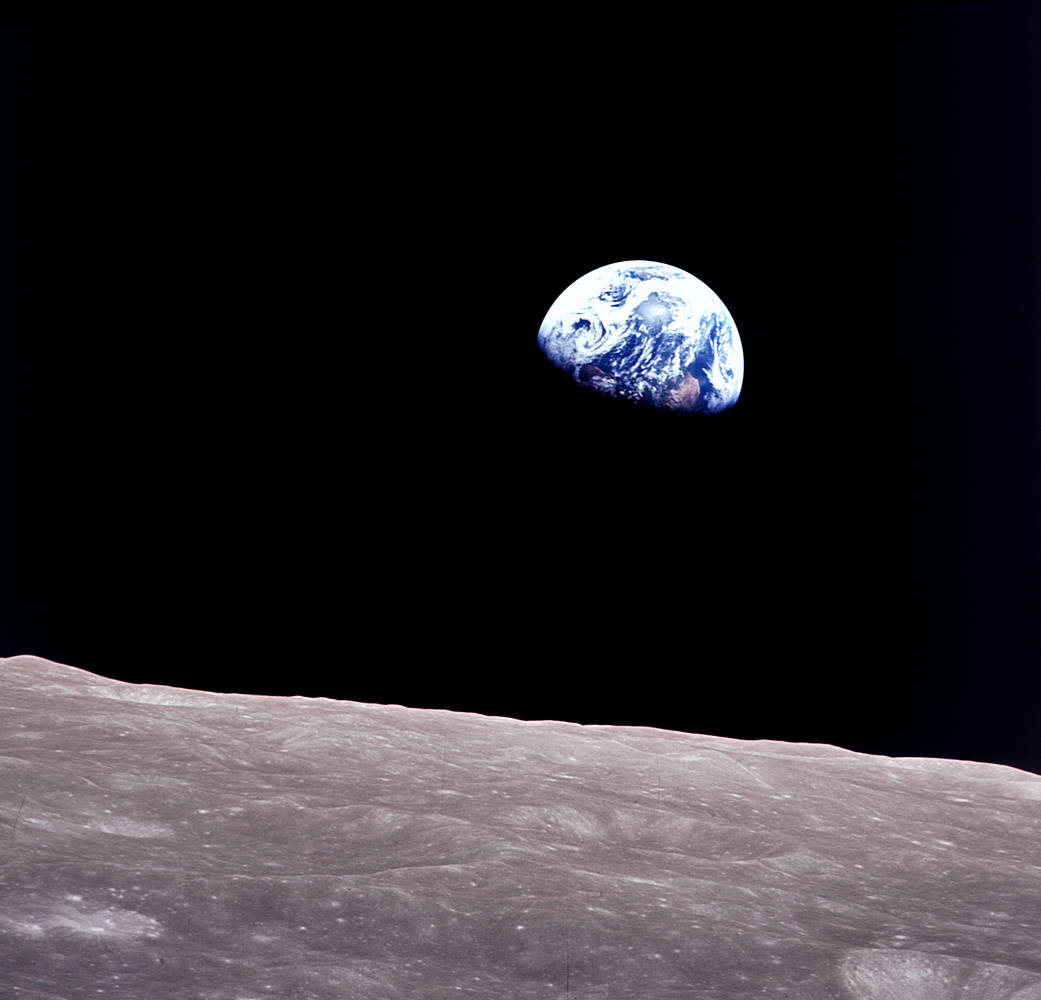
- The Earthrise photo — humanity's home as a fragile blue marble in cosmic darkness
- And now: a serious scientific attempt, developed collaboratively with AI, to create life itself from pure chemistry
Earthrise as Philosophy
Earthrise (Apollo 8, December 24, 1968) became an environmental and civilizational mirror. Scientific truth: we are alone in the void. Human meaning: this fragile world is ours to understand and protect. Perspective: borders, nations, and religions are invisible from space — revealed as human constructs. The image is both humbling and elevating.
That photograph changed how a generation thought about life, about Earth, about what matters. Fifty-eight years later, the question of what life actually is — at its minimum, at its origin, at its threshold — has become a personal scientific obsession.
Your Contribution Matters
Every "minor" contribution is part of a collective tapestry — engineers solving one problem, teachers inspiring innovators, colleagues asking the right question. At United Airlines, the Modem Sharing Device and the Apollo data communications network. At Apparat Inc., NewDos for TRS-80 and IBM PC add-on boards reaching $25M in sales over nine years. Progress is cumulative and shared. Each contribution earns the right to attempt the next one.
The Wisdom of Gratitude Over Fear
You pivot from AI weapons and nuclear risk to a choice: engage fully with the rest of life on Earth. That's Stoic, practical, and courageous — control what you can, honor what you've lived, stay curious. Gratitude is not passive. It is the engine of continued effort.
A Gift to Younger Generations
Your earned perspective is a gift: you've seen both destructive capacity and creative brilliance, crises navigated, progress achieved — choosing engagement without illusions. The most valuable thing an 85-year-old engineer can offer a 25-year-old biochemist isn't money or credentials. It's a framework — a way of seeing a problem that decades of engineering discipline makes possible.
The Best of Times Paradox
Child mortality plummeted, literacy soared, poverty declined, life expectancy rose, and science flourished — while nuclear weapons, climate change, and existential technologies emerged simultaneously. Best and worst of times. The response is not paralysis. It is the next experiment.
Your Choice of Joy
"Tragic optimism": hold darkness in view while choosing light. Viktor Frankl wrote about the final freedom — to choose one's attitude. At 85, your choice is joy and continued engagement. That is an act of resistance against despair. And it turns out, joy and rigor are not opposites. The most joyful thing an engineer can do is attempt something genuinely hard.
One Last Audacious Project
There is a final chapter to this story that wasn't written when this page was first created. After decades of engineering, of building systems and companies and technologies, something unusual happened: an 85-year-old retired electrical engineer from Sahuarita, Arizona — working with AI as a research partner — developed what peer reviewers are calling a scientifically serious proposal to create life from scratch.
Not metaphorically. Not computationally. Chemically. Starting from molecules. No biological material of any kind. A geochemical reactor recreating the conditions of ancient Earth's hydrothermal vents, designed to ask whether chemistry alone — given the right gradients, the right surfaces, the right thermal cycling — can cross the threshold into something that replicates, varies, and evolves.
Creating Life From Scratch: A Staged, Ecosystem-Dependent Pathway
The project rests on a remarkable 2025 discovery: Candidatus Sukunaarchaeum mirabile, the smallest known living organism on Earth. It has only 189 genes, no independent metabolism, and is totally dependent on its host for survival. And it is unambiguously alive. It replicates. It evolves. It simply cannot do any of that without the chemical support of its environment.
This organism is not a curiosity. It is a proof of concept: life at its absolute minimum does not require independence or complexity. It requires only four measurable things — heritable information, bounded-error replication, variation, and selection. Everything else is optional. The project proposes to build a reactor that provides what Sukunaarchaeum gets from its host, and ask whether pure chemistry can meet those four criteria on its own.
The Science, in Plain English
The central barrier between chemistry and life is called the error catastrophe — a physical constraint identified by Manfred Eigen in 1971. When molecules copy themselves without enzymatic help, they make mistakes. At a 10% error rate per base, the maximum viable genome is 10 bases. At 1%, it's 100 bases. The minimum genome needed for translation machinery is around 500 bases. Non-enzymatic chemistry produces error rates of 7–26%. That gap — between what chemistry can currently achieve and what life requires — is the central challenge of the project.
Three mechanisms, each experimentally demonstrated, partially close the gap: passive thermodynamic correction, peptide-assisted fidelity enhancement, and oligonucleotide-catalyzed copying. Whether they work together in a noisy, evolving reactor has never been tested. Testing that assumption is what Stage II of the project does — and the result, whether success or failure, is significant science either way.
The Honest Probability Assessment
Eight independent reviewers converged on the same honest risk profile. This is not a reason not to try. It is the reason the project is designed with pre-registered criteria and go/no-go gates — so that every outcome teaches something:
| Stage | What Must Be Demonstrated | Likelihood |
|---|---|---|
| I — Reactor | Stable geochemical gradients; vesicle formation; oligomer synthesis | High |
| II — Polymer Replication | Template-directed copying; measurable fidelity under reactor conditions | Moderate |
| III — Error Threshold | Fidelity crossing 10⁻³ with three mechanisms co-functioning in noisy environment | Low–Moderate |
| IV — Protocell Coupling | Selective replication inside lipid vesicles over 50+ generations | Moderate if Stage III succeeds |
| V — Translation Emergence | Genetic code arising from scratch within the system | Very Low |
| VI–VII — Full Program | Complete living system meeting all four life criteria; open evolution | Unknown — no precedent |
Even Stage I and II results alone would be landmark science — the first rigorous quantitative measurement of where non-enzymatic replication fails under geochemically realistic conditions, directly constraining which environments in the solar system can and cannot support informational chemistry.
The Family Connection
The project's prospective Principal Investigator is Caroline Hauer — Jim's granddaughter, Research Associate at Dr. Isaac Chan's lab at UT Southwestern's Simmons Comprehensive Cancer Center. Her work on T-cell exhaustion in breast cancer organoids — scaffolded, ecosystem-dependent biology that requires external support to function — is closer to the intellectual core of this proposal than it might initially appear. The reactor-dependent protocell is the same design principle as the organoid: given the right scaffolded environment, the biology does what it cannot do alone.
Caroline brings what the proposal needs: institutional affiliation, biochemistry expertise, lab infrastructure, and the scientific credibility to submit a NASA grant application. Jim brings the engineering framework, the quantitative architecture, and months of research synthesis. It is, if it comes together, a genuine scientific partnership across generations.
The Thread That Connects It All
Looking back at 85, the thread is engineering discipline applied to questions that seemed too large to be practical. The Modem Sharing Device wasn't a philosophical project — it was a specific solution to a specific problem. Apparat wasn't a vision statement — it was a product that sold $25M worth of hardware because it worked. PrivateAI isn't a manifesto — it's a running server in a home lab in Sahuarita serving real users right now.
Creating Life From Scratch follows the same pattern. Not "life is mysterious and profound." But: here are the four measurable criteria. Here is the error threshold calculation. Here is the reactor specification. Here is the go/no-go gate at month 18. Here is what failure teaches. Here is what success would mean.
That's engineering thinking applied to the deepest question biology has ever asked. And it turns out, that combination — rigorous quantitative framing, staged experimental design, honest probability assessment — is exactly what the NASA Exobiology program is looking for.
At 85, you don't need to do the experiments yourself. You need to build the framework clearly enough that someone with the right credentials and the right lab decides it's worth doing. That's the job. The job is almost done.
Ad astra per aspera — to the stars through difficulties — and to meaning through honesty, joy through tragedy, life through mortality. And perhaps, soon, life through chemistry.